
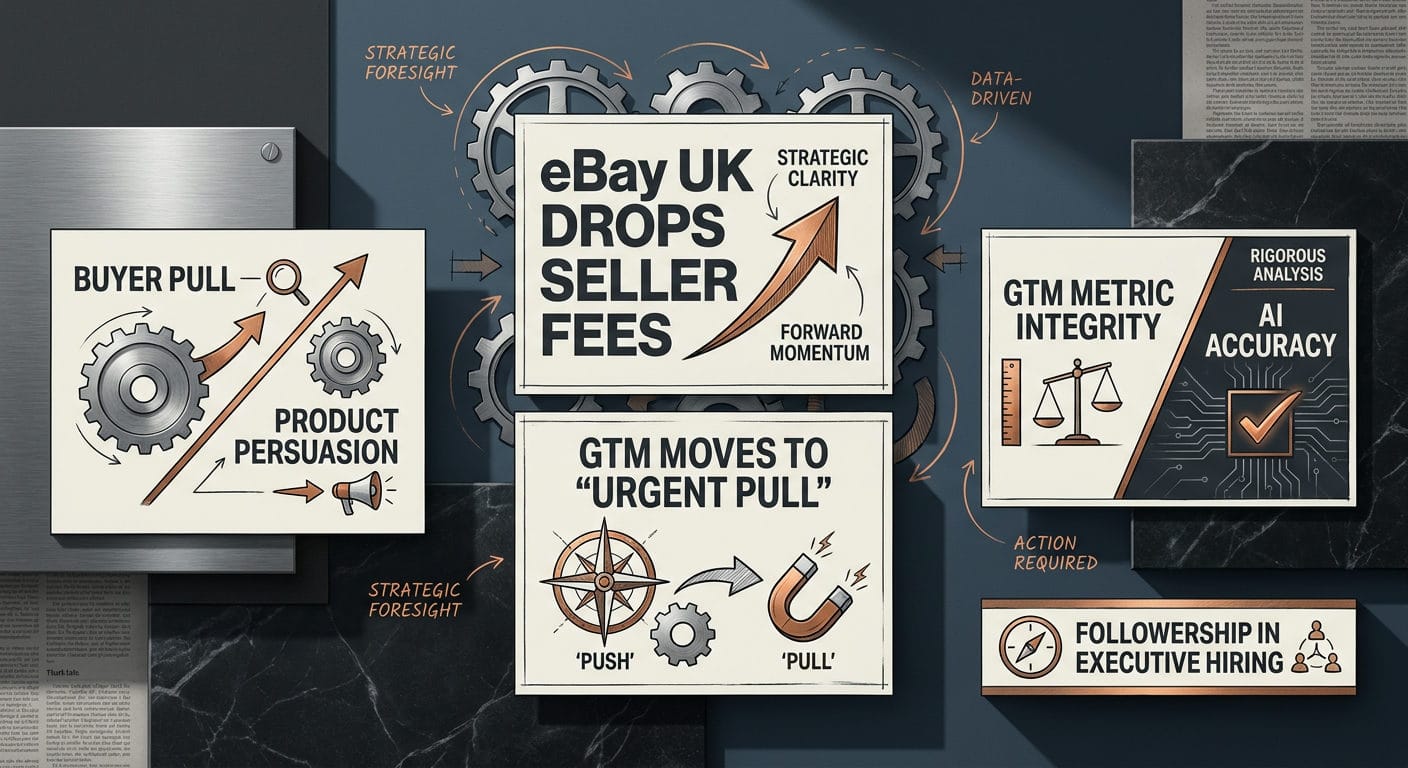
The hardest part of modern go-to-market isn't generating more activity—it's proving that your activity actually results in a buyer with a project they can no longer ignore.
📊 10 episodes across 7 podcasts
⏱ 7 hours 21 minutes of intelligence analyzed
🎙 Featuring: John McMahon, Rob Snyder, Lenny Rachitsky, Dave Gerhardt
|
The Big Shift
The Death of the "Persuasion" Model
The dominant theme across this week’s intelligence is a violent pivot away from "persuading" companies to care and toward identifying individuals with "urgent pull." As Rob Snyder (Author, The Physics of Startups) argues on Lenny’s Podcast, Product-Market Fit isn't a company-wide state; it's a person with a project on their to-do list that they cannot finish using their existing tools.
Why it matters: Most GTM teams suffer from "product myopia," focusing on feature descriptions rather than the buyer’s lived consequences. Mark Stiving (Host, Impact Pricing) notes that large retailers don't buy "container shipping"—they buy "dependable product availability." If your messaging requires the buyer to translate your features into their business outcomes, you have already lost the price premium.
The Human Filter: As AI begins to "do the wrong things faster," human judgment, original thought leadership, and trust-based recruiting are becoming the only defensible assets. Whether it’s John McMahon warning that call-analysis tools cannot validate a true champion, or Devin Reed explaining why Gong banned product pitches in its most successful content, the signal is clear: high-impact GTM now requires doing the things AI cannot—building authentic trust and identifying the "unavoidable project."
"One of the main mistakes people make is thinking that pull is a thing that a company has. It's a thing a person has."
— Rob Snyder, Author of The Power of Pull on Lenny's Podcast
The Rundown
① The "No-Product" Content Rule for LinkedIn Dominance.
Devin Reed (Founder, The Reeder) revealed that content including product screenshots or pitches delivered only one-third the engagement of pure value-add research. (Devin Reed on The Dave Gerhardt Show)
→ Strategic Intent: By enforcing a strict no-pitch rule, brands like Gong earned the trust necessary to dominate specific distribution channels where sales reps actually live.
② The Red Flag of the "Organization-less" Leader.
Mark Thurmond (Co-CEO, Tenable) treats a new hire’s ability to recruit former colleagues as a primary signal of leadership; failing to bring "followers" to a new role is a major hiring warning. (Mark Thurmond on Revenue Builders)
→ Hiring Signal: Authentic leadership is measured by followership, not just historical performance metrics on a resume.
③ Rebuilding vs. Refactoring Tech Debt for Scale.
Russ Mikowski (CEO, SurePeople) argued that a clean rebuild of a decade-old product is often more efficient than untangling "spaghetti code" created by years of bespoke enterprise deals. (Russel Mikowski on Topline)
→ Operational Shift: Stop refactoring roadmap drift; a focused data layer for a specific ICP is more scalable than a broad platform built on custom code.
④ The Webinar Conversion Cliff Fix.
Logan Lyles (Founder, DemandShift) reported that replacing a thank-you page with a segmented survey can lift demo bookings to 8–12% of registrants. (Logan Lyles on The Dave Gerhardt Show)
→ Action Item: Use survey branching to qualify registrants immediately, rather than waiting for post-webinar email follow-ups that rarely convert.
⑤ Marketplace Monetization Pivot: eBay UK. 🆕
eBay 🆕 shifted its UK strategy to remove fees for consumer sellers, moving the monetization burden to buyers who value unique listings and secure transactions. (Yvonne Pop on Impact Pricing)
→ Pricing Insight: When "free" competitors threaten supply, marketplace leaders must monetize the side of the transaction that perceives the most unique value.
Signal Board
🔥 HEATING UP
• The PULL Framework: Identifying prospects with a specific Project, Unavoidable deadlines, and Limitations in current tools. (Rob Snyder on Lenny's Podcast)
• Zero-Click Content: Native LinkedIn distribution and email-to-article flows outperforming owned web traffic. (Devin Reed on The Dave Gerhardt Show)
• Deterministic Dashboarding: Using programmatic code for GTM metrics while restricting AI to qualitative explanations. (Gerry Marletta on GTM Science)
👀 ON WATCH
• eBay UK Pricing: 🆕 A major shift from seller fees to buyer-side monetization as a response to marketplace competition. (Yvonne Pop on Impact Pricing)
• Claude Code: 🆕 Treated as a "junior developer" to build programmatic GTM dashboards under strict human supervision. (Gerry Marletta on GTM Science)
• Synthetic Persona Committees: Using AI to simulate buyer-side executive critiques of marketing materials. (Logan Lyles on The Dave Gerhardt Show)
❄️ COOLING OFF
• Gated Content MQLs: Downloads are now viewed as signals of "problem-solving intent," not immediate "buying intent." (Devin Reed on The Dave Gerhardt Show)
• Call-Analysis Champion Validation: Recognition that AI tools cannot verify if a contact has actual influence or budget authority. (John McMahon on Topline)
The Debate
The Dashboard Dilemma: Should AI do the Math?
There is a growing tension between the speed of AI-generated reporting and the necessity of deterministic accuracy in Revenue Operations.
推动 The Programmatic Case: Gerry Marletta (SVP, Union Square Consulting) argues that the core retrieval, calculation, and display of GTM metrics must remain programmatic—built exactly as they were 15 years ago. "The chatbot is the exception," Marletta insists, noting that an LLM should never be trusted to independently calculate the headline numbers that drive board decisions.
⚖️ The "Vibe Coding" Reality: Conversely, the team used Claude Code as a "junior developer" to build the very infrastructure Marletta describes. While the math is deterministic, the construction of the system is increasingly AI-led, creating a new requirement for leaders to act as high-level architects who "hold the hand" of the AI to ensure security and failure handling aren't omitted.
Synthesis: Trust in GTM data is fragile. Use AI to accelerate the build and provide qualitative context (explaining why a number moved), but keep the actual arithmetic locked in deterministic code.
The Bottom Line
Scale comes from ruthlessly qualifying for "pull" and maintaining human-led metric integrity, even as AI accelerates the execution.
Quick Appendix
GTM Science: "How to Build an Ai-Powered Dashboard" · 64 min · Featuring Gerry Marletta (SVP, Union Square Consulting) ▶ Listen · Apple Podcasts
Who should listen: RevOps leaders looking to balance AI-assisted builds with deterministic data integrity.
Impact Pricing: "Buyer Insight: Buyer-First: The Antidote to Product Myopia" · 5 min · Featuring Mark Stiving (Pricing Expert) ▶ Listen · Apple Podcasts
Who should listen: Product marketers struggling to translate features into quantifiable buyer consequences.
Impact Pricing: "When Free Beats Your Price, Learn From Ebay with Yvonne Pop" · 24 min · Featuring Yvonne Pop (Director, eBay) ▶ Listen · Apple Podcasts
Who should listen: Marketplace operators navigating price wars and value-based monetization shifts.
Lenny's Podcast: Product | Career | Growth: "An 86-minute guide to finding PMF | Rob Snyder" · 86 min · Featuring Rob Snyder (Author, The Power of Pull) ▶ Listen · Apple Podcasts
Who should listen: Early-stage founders and PMs needing a concrete framework for qualifying urgent demand.
Revenue Builders: "Why Performance Comes Before Promotion with Mark Thurmond" · 12 min · Featuring Mark Thurmond (Co-CEO, Tenable) ▶ Listen · Apple Podcasts
Who should listen: Aspiring leaders evaluating career moves based on learning potential rather than titles.
The Cheat Code & Friends: "100 Episodes, Zero Scripts" · 42 min · Featuring Justin Gray, Josh Wagner, Sean Kester ▶ Listen · Apple Podcasts
Who should listen: GTM professionals seeking a high-level synthesis of trust, brand, and AI in the current market.
The Dave Gerhardt Show: "[Best of B2B] Devin Reed on Content Strategy" · 53 min · Featuring Devin Reed (Director, Clari) ▶ Listen · Apple Podcasts
Who should listen: Content leaders aiming to dominate LinkedIn using proprietary data and "zero-click" strategies.
The Dave Gerhardt Show: "Top 5 B2B Webinar Mistakes with Logan Lyles" · 54 min · Featuring Logan Lyles (Founder, DemandShift) ▶ Listen · Apple Podcasts
Who should listen: Demand gen marketers looking to fix the "conversion cliff" between registration and demos.
Topline: "The Man Who Led 100+ CROs | John McMahon" · 74 min · Featuring John McMahon (Author, The Qualified Sales Leader) ▶ Listen
Who should listen: Sales leaders who need to master the craft of enterprise qualification and CEO partnership.
Topline: "Untangling Tech Debt and Finding PMF with Russ Mikowski" · 27 min · Featuring Russ Mikowski (CEO, SurePeople) ▶ Listen
Who should listen: CEOs managing roadmap drift and deciding between refactoring and rebuilding product cores.
