
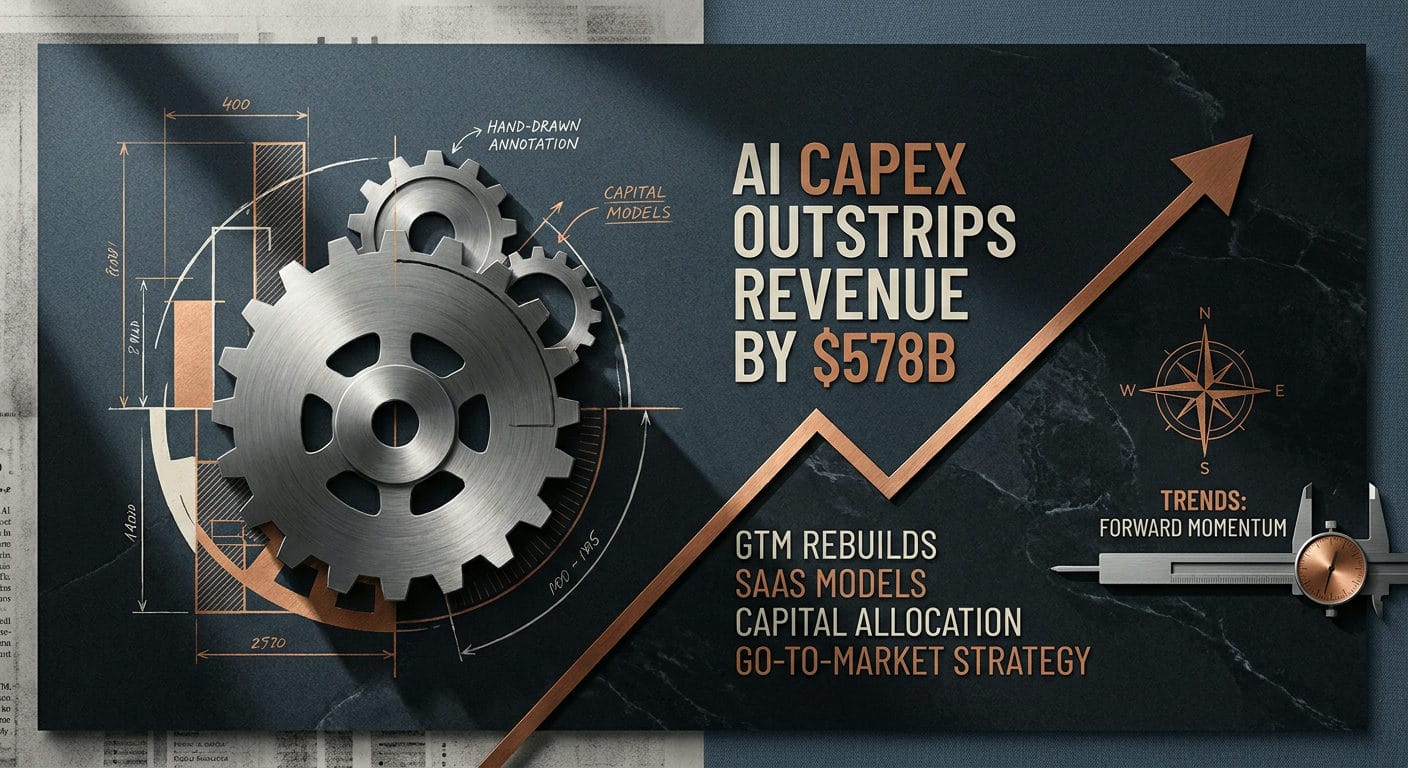
The AI investment boom has far outpaced immediate returns, setting up a volatile, but potentially transformative future for software and GTM strategies.
📊 7 episodes across 5 podcasts
⏱ 322 minutes of intelligence analyzed
🎙 Featuring: Randy Riemersma (Founder, Sell with Precision), John Kaplan (Co-Founder and Host, Force Management), John McMahon (Host, Revenue Builders), Frederik Maris (Co-Founder and Chief Revenue Officer, EliteGTM), Rory O'Driscoll (Software Investor, Scale Venture Partners), SaaStr (Host, SaaStr), Dave Gerhardt (Host, Exit Five), Ryan Narod (VP of Marketing, Rippling), Elizabeth Stone (Chief Product and Technology Officer (CPTO), Netflix), Lenny (Host, Lenny's Podcast), JT Bricker (CEO, Grazzy), Josh Wagner (Host, In Revenue Capital), Sean (Host, In Revenue Capital), In Revenue Capital (Host, In Revenue Capital), Rebecca Busk (CEO and Partner, Kvalifik)
|
The Big Shift
The AI industry is in an unprecedented "invest mode," with capital expenditure vastly outstripping current revenue, creating a unique, high-stakes environment for software companies.
Rory O'Driscoll, Software Investor at Scale Venture Partners, highlighted the staggering imbalance, noting that "We are spending in AI capex, just among the hyperscalers, $688 billion this year. On the other hand... what's coming out the other side is about 110 billion in actual revenues." This half-trillion-dollar delta signals a massive reinvestment into foundational AI capabilities, but it also necessitates a critical reassessment of traditional software business models. O'Driscoll revealed that about 10% of their portfolio companies were "dead on arrival" post-ChatGPT, as AI trivially solved the problems they were built to address.
This capital influx, however, is not just about foundation models; it's driving a need for agent-first architectures in application-layer AI. Rory O'Driscoll suggests that the "million dollar question is how that $1 trillion gets spent between the model companies and then the using AI software companies." This suggests that companies must differentiate themselves beyond traditional SaaS features, leveraging proprietary data, sensor integration, or marketplace models to build defensibility. Meanwhile, Elizabeth Stone, CPTO at Netflix, observed that even as AI blurrs traditional roles, "craft excellence" in engineering, data science, and creativity remains scarce and critical, underscoring that human ingenuity is irreplaceable amid technological shifts.
The imperative for businesses is to navigate this "storming phase" of AI adoption. Companies must identify how new AI capabilities can truly create value, rather than just adding features. This means focusing on "systems thinkers" who can abstract business problems into platform-level solutions and embrace AI fluency across all roles, as advocated by Stone. The market is rewarding capital-efficient, differentiated approaches that solve significant corporate problems, even if they don't achieve the hyper-growth of foundational models (Rory O'Driscoll on The Official SaaStr Podcast: SaaS | Founders | Investors).
The Rundown
① Buyer Confidence, Not Product Gaps, Kills Late-Stage Deals.
Many promising deals fall apart at the last minute because buyers lack the confidence to commit, rather than any deficiency in the product itself. (Randy Riemersma, Founder of Sell with Precision on Revenue Builders)
→ Key Takeaway: Elite sellers differentiate themselves by building buyer conviction through executive alignment and credible proof points, transforming perceived job risk into urgency and belief.
② Sales Leaders Must Convert Instinct into Conscious Competence.
The most effective sales leaders move beyond unconscious, innate talent to explicitly understand and articulate the "science behind the art" of sales performance. (Frederik Maris, Co-Founder and Chief Revenue Officer at EliteGTM on Revenue Builders)
→ Strategic Imperative: CROs need to systemize organizational knowledge and equip frontline managers to coach new reps effectively, reducing attrition and accelerating time-to-first-deal. John McMahon noted, "If you don't know why you're good and you, you're unconsciously competent, I think you're going to really struggle."
③ B2B Brands Thrive on Authentic, Human-First Content Over High Production Value.
Even with substantial budgets, building a recognizable B2B brand like Rippling prioritizes scrappy, human-led content and authentic narratives over solely high-production campaigns. (Ryan Narod, VP of Marketing at Rippling on The Dave Gerhardt Show (from Exit Five))
→ Actionable Insight: Focus on content that features real faces and stories, as Dave Gerhardt highlighted, "the best ads we did early on were just like, this seemed, you know, so counterintuitive at the time. I'd take a picture with the iPhone in the office and use it as an ad."
④ AI Shifts Focus to "Systems Thinkers" and Cross-Functional Fluency.
Netflix is evolving its talent strategy to prioritize "systems thinkers" who can abstract business problems and develop platforms, reducing the need for narrow, deep specialization. (Elizabeth Stone, Chief Product and Technology Officer (CPTO) at Netflix on Lenny's Podcast: Product | Career | Growth)
→ Talent Strategy: Companies should foster "AI fluency" across all roles and seek generalists adaptable in multiple directions, as Elizabeth Stone noted, "The days of very narrow, deep specialization feel more limited to me."
⑤ Sustainable SaaS Growth Demands Deep Dive into Unit Economics and Customer Value.
In the current environment, prioritizing top-line bookings without rigorous attention to unit economics, pricing, packaging, and customer usage leads to unsustainable growth and high churn risk. (JT Bricker, CEO of Grazzy on The Cheat Code & Friends)
→ Operational Focus: Shift from a renewal-centric customer success model to daily, value-driven engagement, with JT Bricker highlighting that "Good customer success... does a good portion of the selling on the front end of the business."
⑥ AEO Requires Unique, Experience-Driven Content to Rank, Not Generic AI Outputs.
For content to be cited in AI search, it must be inherently unique, providing expert insights, specific data, and original experiences, rather than sounding like the 2000 other AI-generated pages. (Rebecca Busk, CEO and Partner at Kvalifik on The Dave Gerhardt Show (from Exit Five))
→ Content Strategy: Marketers must integrate external validation and authenticity, with Rebecca Busk stating, "If you want to be sighted, you should not sound like the 2000 other sites that are out there. You need to provide something that's unique."
Signal Board
🔥 Heating Up
• Rippling: VP of Marketing Ryan Narod highlighted their strategic balance of high-production and scrappy Lo-Fi video content, proving both effectively build brand and drive performance. (Ryan Narod on The Dave Gerhardt Show (from Exit Five))
• Conscious Competence for Sales Leaders: Frederik Maris stressed the necessity for sales leaders to move beyond unconscious instinct to explicit understanding (Frederik Maris on Revenue Builders)
• SaaStr multiples collapse and growth rates: Rory O'Driscoll discussed how the market now heavily scrutinizes profit drivers and capital expenditure efficiency, particularly for AI companies. (Rory O'Driscoll on The Official SaaStr Podcast: SaaS | Founders | Investors)
👀 On Watch
• Rebecca Busk (CEO and Partner, Kvalifik) 🆕: CEO of Kvalifik pushing the concept of AEO (AI Search Optimization) as the evolution of SEO, and the need for unique content over generic AI. (Rebecca Busk on The Dave Gerhardt Show (from Exit Five))
• AI search and content citation 🆕: Identified as the next frontier in SEO, requiring original, experience-driven content to be relevant and cited by LLMs. (Rebecca Busk on The Dave Gerhardt Show (from Exit Five))
• AEO content strategy vs. AI usage 🆕: A critical distinction where AI is seen as a tool for research/editing, not content generation, if aiming for AI search citations. (Rebecca Busk on The Dave Gerhardt Show (from Exit Five))
• Rebecca Busk's 'rule of four' for content structure (Answer, Explain, Prove, Expand) 🆕: A framework designed to optimize content for LLM understanding and citation. (Rebecca Busk on The Dave Gerhardt Show (from Exit Five))
• External validation signals for AI authority (Reddit, G2, awards) 🆕: These sources are gaining more weight for AI citations than traditional professional networks like LinkedIn. (Rebecca Busk on The Dave Gerhardt Show (from Exit Five))
❄️ Cooling Off
• Zoologists versus Hunters in Sales: The idea that sales teams struggle when they over-specialize in nurturing vs. actively pursuing deals, leading to less effective outbound motion. (Frederik Maris on Revenue Builders)
• LinkedIn social signals not currently used by LLMs 🆕: Rebecca Busk argues that AI does not currently prioritize LinkedIn for social proof, challenging its authority as an external validation signal for AI search. (Rebecca Busk on The Dave Gerhardt Show (from Exit Five))
• Don't write AEO content with AI 🆕: A contrarian view from Rebecca Busk, stating that generic AI-generated content struggles to rank or be cited in AI search, necessitating unique insights. (Rebecca Busk on The Dave Gerhardt Show (from Exit Five))
• Traditional SaaS customer success mentality is inadequate for consumption-based models: JT Bricker emphasizes how a focus solely on renewals, rather than continuous value and usage, is a recipe for churn in the consumption era. (JT Bricker on The Cheat Code & Friends)
The Bottom Line
The AI investment surge is separating enduring software value from fleeting features; GTM must now build buyer confidence and provide unique, human-centric solutions to thrive.
📖 Want the full episode breakdowns, guest details, and listen links?
Quick Appendix
Revenue Builders: "Why Deals Die Inside the 10-Yard Line with Randy Riemersma" · 10 min · Featuring Randy Riemersma
For Revenue Leaders: This episode provides critical insights into why late-stage deals fail—it's often about buyer confidence, not product features—making it essential for sales leaders to refine their executive engagement strategies.
▶ Listen
Revenue Builders: "How Great Sales Leaders Turn Instinct Into a System with Frederik Maris" · 65 min · Featuring Frederik Maris
For Sales Enablement & Managers: Frederik Maris's call for "conscious competence" offers a framework for developing sales leaders who can systematize success, crucial for reducing new rep attrition and improving overall team performance.
▶ Listen
The Official SaaStr Podcast: SaaS | Founders | Investors: "SaaStr 868: Software Isn't Dead. It's Gotten Harder with Scale Venture Partners' Rory O'Driscoll" · 38 min · Featuring Rory O'Driscoll
For SaaS Founders & Investors: Rory O'Driscoll breaks down the AI investment landscape, providing a vital perspective on defensibility against foundation models and how to secure capital in an agent-first world.
The Dave Gerhardt Show (from Exit Five): "How to Build a Brand in B2B with Ryan Narod (VP of Marketing at Rippling)" · 44 min · Featuring Ryan Narod
For B2B Marketers: Ryan Narod's discussion on Rippling's strategy for building a B2B brand with human-first content offers actionable insights for marketers looking to balance performance and brand-building effectively.
Lenny's Podcast: Product | Career | Growth: "Netflix CPTO on AI and the future of product and tech roles | Elizabeth Stone" · 72 min · Featuring Elizabeth Stone
For Product & Tech Leaders: Elizabeth Stone's insights into Netflix's talent strategy, emphasizing "systems thinkers" and "AI fluency," are crucial for leaders navigating the evolving roles in product and tech.
The Cheat Code & Friends: "Priorities, Adoption and Misalignment - Season 5: Episode # 93" · 49 min · Featuring JT Bricker
For SaaS Executives: JT Bricker's focus on unit economics and consumption models provides vital intelligence for SaaS leaders seeking to build sustainable growth and mitigate churn in today's competitive market.
The Dave Gerhardt Show (from Exit Five): "Why AEO in 2026 Is Just the Evolution of SEO with Rebecca Busk (CEO, Kvalifik)" · 44 min · Featuring Rebecca Busk
For Content & SEO Strategists: Rebecca Busk's deep dive into AEO (AI Search Optimization) reveals why unique, experience-driven content is paramount for visibility, challenging generic AI content approaches.
